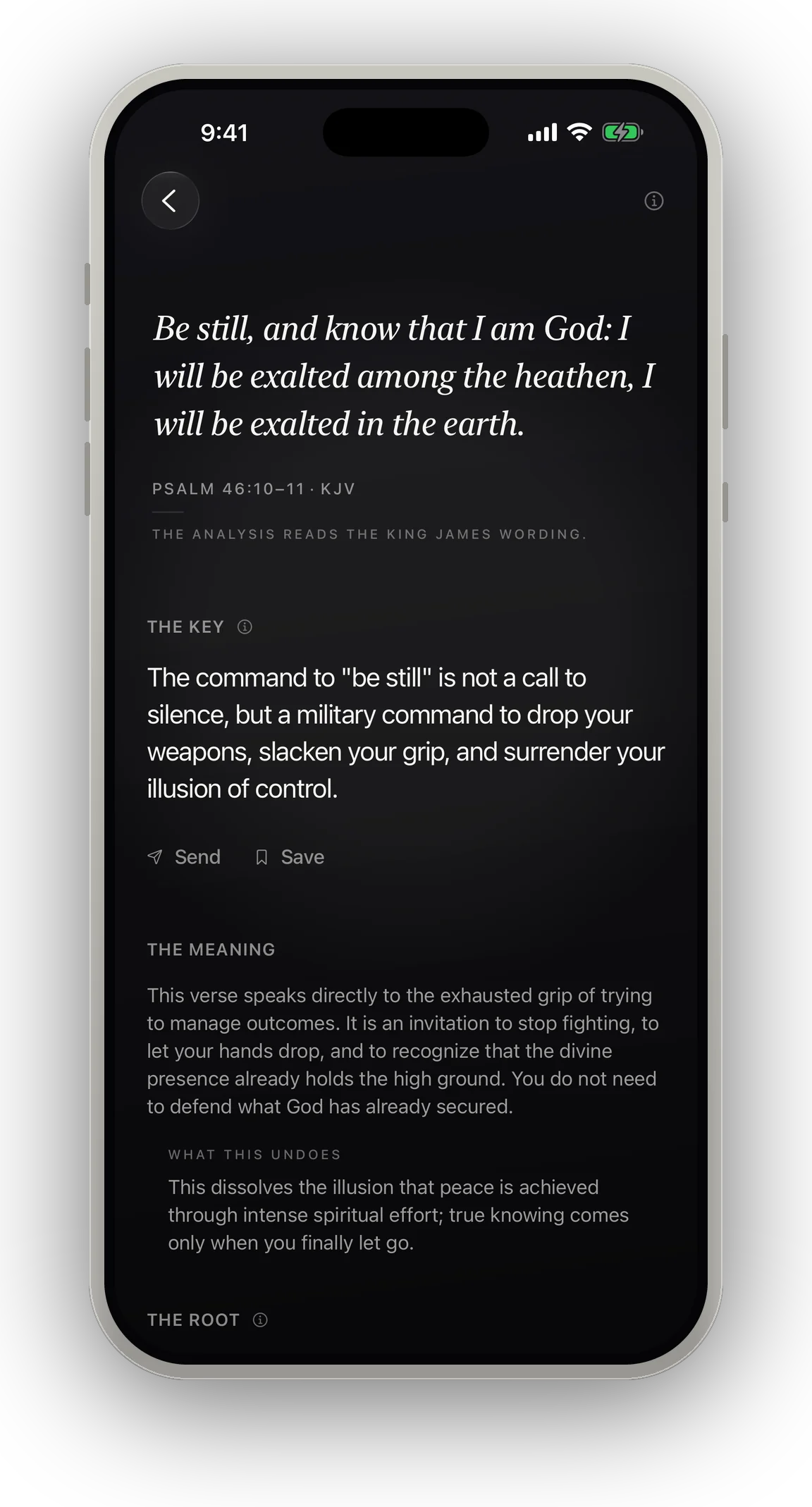
Be still, and know that I am God: I will be exalted among the heathen, I will be exalted in the earth. The LORD of hosts is with us; the God of Jacob is our refuge. Selah.
The analysis reads the King James wording.
THE KEY
Stillness here means releasing your grip so you can perceive that God is already present as refuge.
THE MEANING
The verse meets you at the point of your grip: “Be still” carries release, and “know” means perceive who God is. Nations and earth remain in view, yet God’s exaltation does not depend on their calm or consent. The God named here is with you as a high refuge; Selah leaves the claim held in silence.
WHAT THIS UNDOES
It undoes the belief that you must control the upheaval before God’s presence can be known. The verse places refuge with you while the nations and earth are still unsettled.
THE ROOT
הַרְפּוּ
harpu
GROWS FROM
רפה
Slacken, loosen, release, let drop.
“Be still” in this verse is harpu. The imperative carries the sense of letting go; the same root can describe slackness or easing. Stillness begins as what stops gripping, and knowing follows as recognition rather than a fact forced into the mind.
ALSO GROWS
raphah — To slacken, relax, or let fall.
רָפָה
This verb shows stillness as loosening what is held tight, not manufacturing a new state.
rephiyon — Slackness or ease.
רִפְיוֹן
The related noun preserves the root’s sense of lowered tension beneath the English word “still.”
דְּעוּ
de'u
GROWS FROM
ידע
Know, recognize, perceive.
This root reaches beyond information to recognition through relationship. “Know that I am God” points to perceiving who God is, not merely holding a statement about God.
ALSO GROWS
yada — Know or recognize.
יָדַע
The verse’s command uses this root: release is followed by recognition of who God is.
moda — Acquaintance or kinsman.
מֹדָע
A related word can name someone known as kin, carrying personal connection within the root’s field of knowing.
מִשְׂגָּב
misgav
GROWS FROM
שגב
Be high, lofty, or inaccessible.
Misgav is a high place or stronghold, so refuge carries the sense of elevation and security, not only concealment. This refuge is with us while the nations and earth remain in view.
ALSO GROWS
sagav — Be high, lofty, or inaccessible.
שָׂגַב
The verb gives the refuge its image of safety above the reach of threat.
misgav — High place, stronghold, or refuge.
מִשְׂגָּב
The verse names God’s presence as this elevated shelter.
THE PATTERN
When the grip loosens, recognition settles on a presence whose refuge remains steady while the world is unsettled.
The LORD shall fight for you, and ye shall hold your peace.For thus saith the Lord GOD, the Holy One of Israel; In returning and rest shall ye be saved; in quietness and in confidence shall be your strength: and ye would not.Casting all your care upon him; for he careth for you.THE THREAD
The LORD also will be a refuge for the oppressed, a refuge in times of trouble.The word translated “refuge” in both verses is מִשְׂגָּב (misgav), a high stronghold. Psalm 9 names that refuge for the oppressed in trouble; Psalm 46 reveals that this high shelter is with you.
Selah Verse is not available yet.
This reading is from Selah Verse, where any verse can be read this way. There is nothing to download today. Leave your email and we will write once, on the day it is.
Does something in this reading look wrong? Tell us